The End of the Prompt: Why Marketers Are Ditching Reactive AI for Autonomous Marketing
ActiveCampaign's autonomous marketing replaces the copy-paste AI chaos with 25 agents that work alongside you. Here's what it costs.
Table of Contents
The AI Frankenstein problem
For the last two years, we’ve been told AI would revolutionize our marketing. And technically, it has — we just didn’t expect it to create an entirely new job in the process.
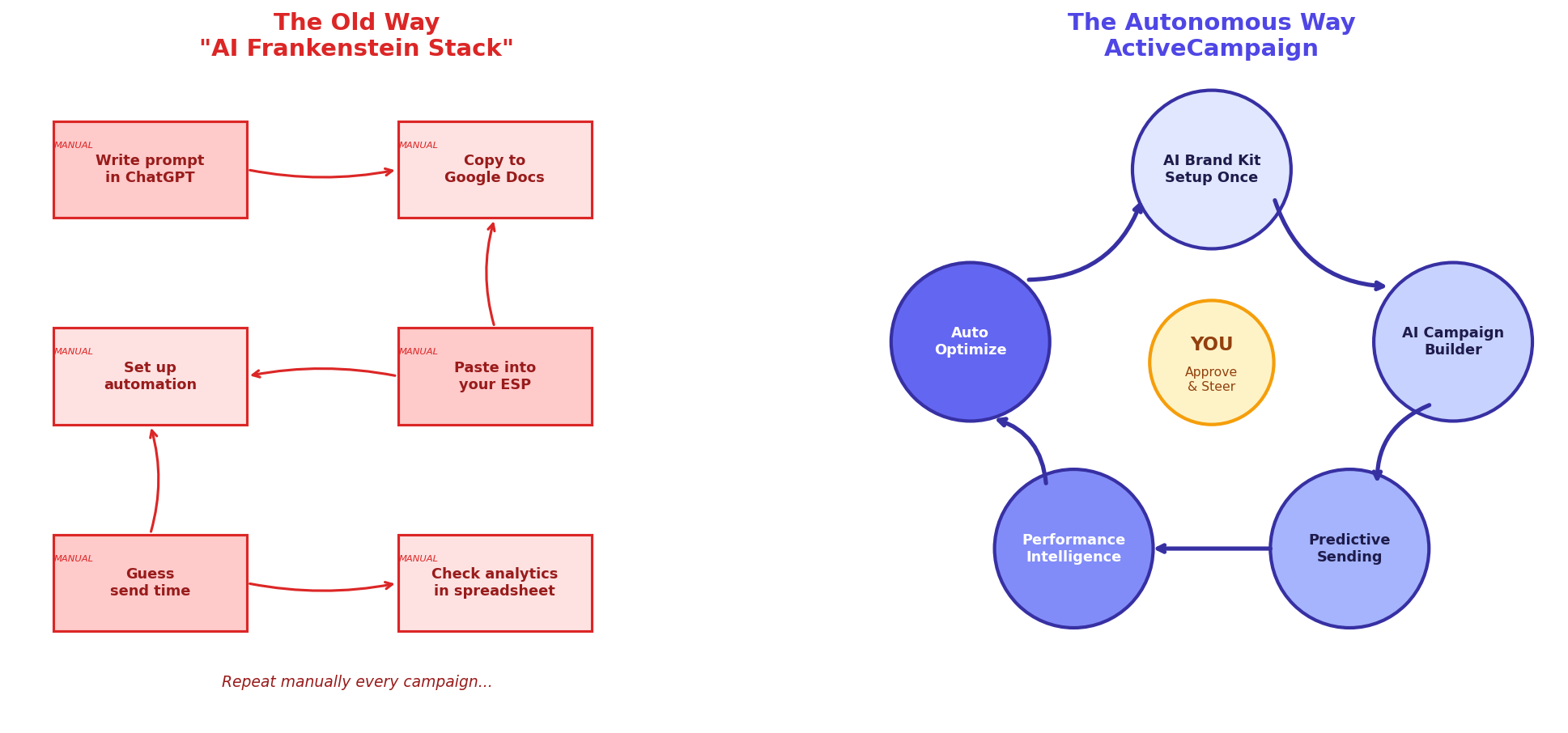
Here’s what “AI-powered marketing” looks like for most small businesses in 2026: You open ChatGPT, spend 15 minutes writing a prompt for a welcome email. It spits out something decent. You copy it into Google Docs, tweak the tone because it sounds like a robot wrote it, then paste it into your ESP. You manually set up the automation trigger, guess at the send time, and hit publish. A week later, you open a spreadsheet to check if anyone actually clicked anything.
That’s not AI-powered marketing. That’s being an unpaid copy-paste intern for a large language model.
I’ve been analyzing SaaS pricing for a while now, and I started noticing something interesting: the platforms that bolt on “AI features” as an afterthought — generate a subject line here, suggest a send time there — aren’t actually saving anyone meaningful time. The workflow is still fundamentally manual. You’re just outsourcing the writing to a chatbot and doing everything else yourself.
Then I spent a week digging into what ActiveCampaign is building with their autonomous marketing platform, and something clicked. They’re not adding AI features to an email tool. They’re building a system where AI runs the marketing loop end-to-end — and the human’s job shifts from “do the work” to “approve the work.”
That’s a genuinely different architecture. And it’s worth understanding, whether you end up using AC or not.
Reactive AI vs. autonomous AI: why the distinction matters
Most marketing AI today is reactive. You give it an input, it gives you an output. Write me a subject line. Suggest a segment. Optimize this send time. It’s useful, but it’s essentially autocomplete with extra steps. You still have to know what to ask for, when to ask for it, and what to do with the answer.
ActiveCampaign’s pitch — and their Spring 2026 Innovation Keynote on April 8 is built around this — is what they call “agent-to-user AI.” Instead of waiting for you to prompt it, the AI monitors your campaigns continuously, spots problems, and brings them to you with a recommended fix.
Jason VandeBoom, their CEO, put it this way: “The future of marketing isn’t just AI that responds when asked; it’s AI that works alongside you.”
In practice, that means something like: your welcome sequence open rates dropped 18% last Tuesday. You didn’t notice because you were doing fourteen other things. But ActiveCampaign’s AI Performance Intelligence caught it, diagnosed that the subject line was underperforming against comparable campaigns in their dataset, and drafted an optimized version. It’s sitting in your dashboard when you log in, waiting for one click to deploy.
That’s the difference. Reactive AI needs you to ask “why are my open rates dropping?” Autonomous AI tells you before you think to ask.
Chris Clark, who runs the racquet sports company Toss and Spin, described it simply: “Before ActiveCampaign, we were spending time we didn’t have trying to figure out why our marketing wasn’t working. Now the platform tells us clearly where to focus.” They’re operating at 90% facility capacity.
Your $59/month marketing agency
Here’s what caught my attention when I mapped out ActiveCampaign’s AI capabilities. They have 25+ specialized AI agents. Not one chatbot doing everything — twenty-five distinct agents, each built for a specific job. ActiveCampaign organizes them into three departments, and honestly, the framework makes more sense than most agency org charts I’ve seen.
The Creative Department (Imagine)
This is your copywriter, designer, and strategist rolled into one. The AI Campaign Builder takes a plain-language goal — “launch a Black Friday early access campaign for repeat customers” — and generates the full campaign: email content, images, layout, subject lines, all in your brand voice.
The brand voice part matters. ActiveCampaign’s AI Brand Kit lets you import your brand identity from your URL once, and every agent references it from that point on. No more “write this in a friendly but professional tone, not too casual, avoid exclamation points” prompt engineering. You set it once. It sticks.
Other agents in this department: AI Content Generation for on-brand copy and images, AI SMS Builder for text campaigns, AI Translations for multi-language campaigns, and AI-Suggested Segments that surface high-value audience groups you might not have thought to create.
The Operations Department (Activate)
This is the execution layer — the agents that actually build and run your automations. AI-Suggested Automations recommends workflows based on your data. The AI Actions Library lets you assign tasks to AI directly inside your automation flows, so the AI doesn’t just build the automation — it becomes a step within it.
And then there’s the MCP Server, which is in beta but worth watching. MCP stands for Model Context Protocol, and it lets you connect Claude, ChatGPT, or Cursor directly to your ActiveCampaign account. Pull campaign metrics, update contacts, trigger automations — all from your external AI tools, without switching tabs or building Zapier chains that break every time an API updates.
For developers and power users, this is significant. It means your AI assistant has live access to your actual customer data, not a stale CSV export from last Tuesday.
The Analytics Department (Validate)
This is where the “autonomous” part gets real. Predictive Sending analyzes each contact’s behavior patterns and delivers emails at the exact time they’re most likely to engage — not “Tuesday at 10am” for everyone, but a personalized window for each subscriber.
BotSense cleans fake contacts from your list automatically, which matters more than people realize for deliverability. Spam Check catches issues before you hit send. Sentiment Analysis tracks how your audience feels about your campaigns at scale. And the Business Goals dashboard ties everything back to actual business outcomes, not just vanity metrics.
The new additions coming April 8 — AI Performance Intelligence, AI Content Optimization, and Autonomous Campaign Optimization — complete the loop. The AI doesn’t just execute your campaigns. It watches them perform, diagnoses issues, generates fixes, and presents them for approval. The flywheel spins on its own.
The economics that make this click
Here’s where this gets interesting from a pricing standpoint.
To get comparable AI-powered marketing automation from HubSpot — predictive sending, AI content, custom objects, multi-channel orchestration — you’re looking at their Marketing Hub Professional tier. That starts at $800/month. Enterprise is over $3,600/month.
ActiveCampaign unlocks generative AI on the Plus plan at $59/month. Predictive Sending and A/B automation testing come in at Pro for $99/month. Even at the Enterprise tier with every bell and whistle, you’re at $179/month for 1,000 contacts.
That’s not a small gap. That’s a completely different market. HubSpot’s AI is built for companies with marketing departments. ActiveCampaign’s autonomous platform is built for the solo operator who is the marketing department.
Quick pricing reference: where each AI feature lives
| AI Feature | Minimum Plan | Price (1K contacts) |
|---|---|---|
| AI Campaign Builder | Plus | $59/mo |
| AI Brand Kit | Plus | $59/mo |
| AI Content Generation | Plus | $59/mo |
| AI-Suggested Segments | Plus | $59/mo |
| AI-Suggested Automations | Plus | $59/mo |
| MCP Server (Beta) | Plus | $59/mo |
| Predictive Sending | Pro | $99/mo |
| A/B Automation Testing | Pro | $99/mo |
| Conditional Content | Pro | $99/mo |
| AI Performance Intelligence | Pro | $99/mo |
| Custom Objects | Enterprise | $179/mo |
Pricing verified March 2026. All prices reflect monthly billing.
The Starter plan at $19/month gets you solid automation basics, but the AI features really begin at Plus. If you’re evaluating ActiveCampaign specifically for autonomous marketing capabilities, Plus is the entry point worth considering.
The blank canvas is dead
Marketing used to start with a blank screen and the question: “What should I send today?”
That question is becoming obsolete. Not because AI writes your emails for you — every platform does that now, and the output is usually mediocre. But because the platforms that are pulling ahead aren’t just generating content. They’re watching performance, spotting opportunities, diagnosing problems, and presenting ready-to-deploy solutions.
The shift from reactive to autonomous isn’t about replacing marketers. It’s about changing what a marketer’s job actually is. Less time prompting a chatbot and reformatting the output. More time on strategy, creative direction, and the human judgment calls that AI genuinely can’t make.
ActiveCampaign is betting their entire product roadmap on this shift. Whether they’re right — and whether the April 8 keynote delivers on the promise — we’ll find out soon. But the direction is clear, and at $59/month for the full AI suite, the barrier to trying it yourself is lower than almost anywhere else in the market.
Try ActiveCampaign’s autonomous marketing platform →
Methodology: AI feature availability verified against ActiveCampaign’s platform pages (activecampaign.com/platform/autonomous-marketing, /artificial-intelligence, /use-cases/ai-agents) and press releases as of March 25, 2026. Pricing verified directly from activecampaign.com. HubSpot pricing from hubspot.com/pricing/marketing. April 8 keynote details from ActiveCampaign’s official press release (March 18, 2026). Customer quotes sourced from ActiveCampaign’s published case studies.
PriceWorld earns affiliate commissions from some links on this page. This doesn’t influence our analysis — we track the same pricing data whether or not an affiliate program exists.